
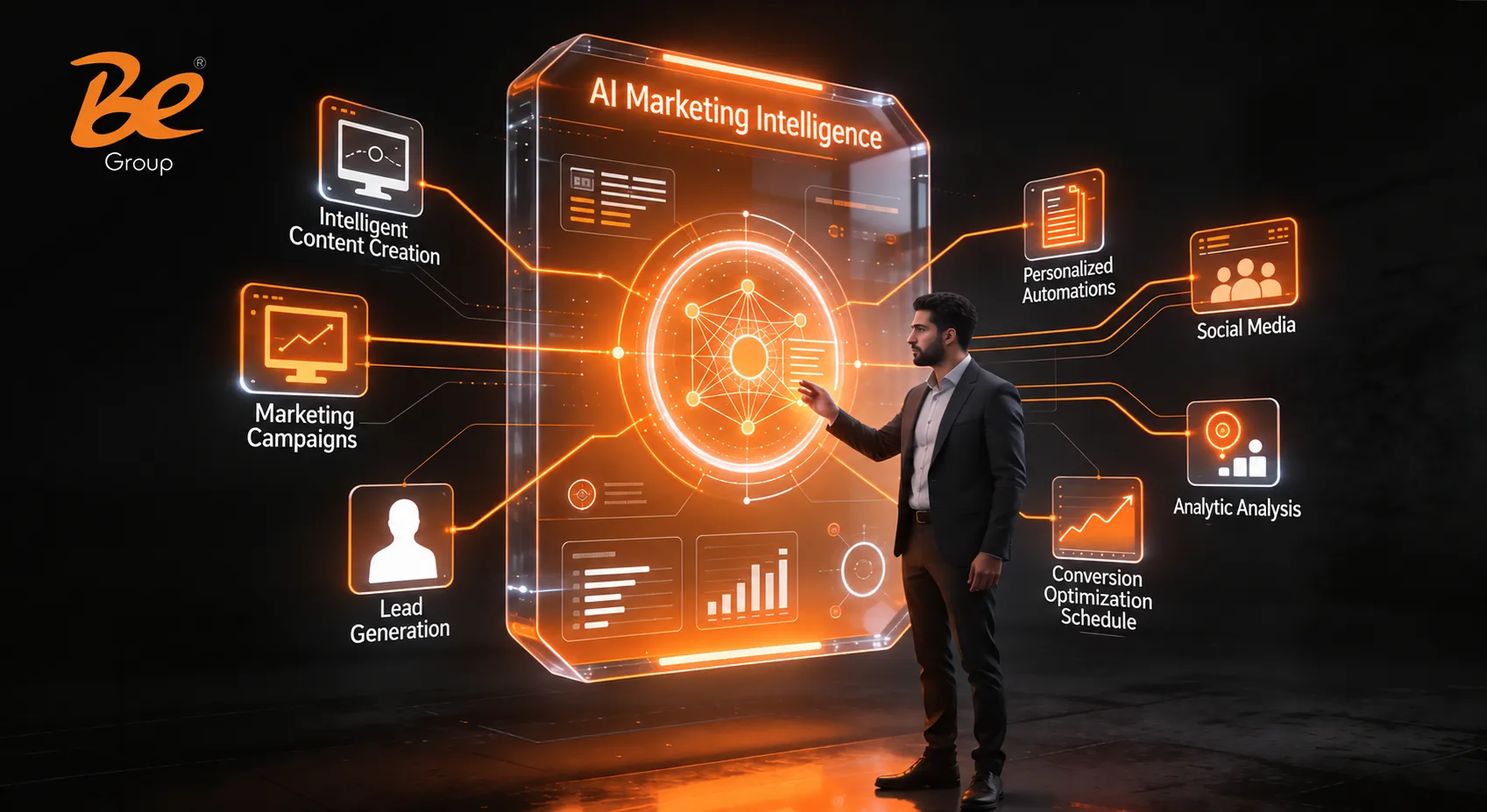
Artificial intelligence is now a part of everyday marketing. It helps brands understand customers, create more relevant experiences, and make faster decisions across the customer journey. But using AI does not automatically lead to better results.
The real advantage comes from applying it with a clear business purpose, reliable customer data, and human judgement.
Effective AI marketing combines intelligent technology with strategic thinking to help brands grow while maintaining trust and strengthening customer relationships.
What Is AI in Marketing?
Artificial intelligence in marketing means using systems that analyze information, identify patterns, generate material, predict outcomes, or automate decisions.
It can help teams understand audiences, create campaign variations, recommend products, choose the best time to reach customers, and adjust advertising.
A practical AI marketing system may combine:
- Predictive AI to estimate purchases, customer churn, or future demand.
- Generative AI to create drafts of text, images, emails, and advertisements.
- Machine learning to improve recommendations using relevant data.
- Automation to complete repeated tasks based on defined rules.
- AI agents to manage connected steps within approved limits.
These tools do not replace positioning, customer research, creative judgment, or accountability. They make valuable work faster when the strategy is clear.
Turn technology into decisions with Be Group.
How Artificial Intelligence Supports the Customer Journey?
Customers rarely move directly from seeing an advertisement to making a purchase. They may search, compare, read reviews, watch videos, leave a website, and return later.
Artificial intelligence can connect signals from these touchpoints and help marketers respond more effectively.
Common applications include:
- Finding audience segments with similar behavior.
- Identifying questions customers research before purchasing.
- Personalizing website content, emails, and product recommendations.
- Producing creative variations for structured testing.
- Moving advertising budgets toward valuable actions.
- Summarizing data and highlighting unusual changes.
AI marketing creates value when every application supports a defined journey stage. A recommendation engine may help an ecommerce customer choose a product, while lead scoring can help a B2B digital marketing sales team prioritize enquiries.
Technology should solve a specific problem instead of being added because it is available.
Benefits and Limits Businesses Should Understand
The main benefits are speed, scale, consistency, and the ability to process more information than a team could review manually. Marketers can reduce repetitive tasks, test ideas faster, and improve relevance.
However, an output may contain incorrect facts, bias, weak language, or recommendations based on incomplete data. Customer information also needs appropriate consent, access controls, and secure handling.
Teams should review claims, protect confidential data, document approvals, and monitor performance after launch.
Responsible AI marketing keeps people accountable for final decisions. Its strongest use is helping experienced teams make faster, better-supported choices without losing the brand’s voice or the customer’s trust.
Ask Be Group where artificial intelligence can add measurable value to your marketing.
How to Start AI Marketing?
Start with one business problem, not a collection of tools. Choose a task where artificial intelligence could improve a measurable result, such as lead qualification, abandoned-cart recovery, or advertising efficiency.
Follow these steps:
- Define the result and record performance.
- Check which customer and campaign data is accurate and usable.
- Select one low-risk use case with a clearly assigned owner.
- Choose a tool that integrates with the existing workflow.
- Set rules for privacy, brand voice, factual review, and human approval.
- Run a limited test and compare quality, time, cost, and commercial results.
A successful AI marketing pilot should be controlled and measurable. If it improves the outcome, expand it safely. If it produces poor results, identify whether the cause is the data, instructions, tool, or process before spending more.
Plan your first test with Be Group.
What AI Tools Are Used in Marketing?
The right tools depend on the task, the company, the available data, and existing platforms. AI Marketing tools generally fall into several groups:
- Customer data and automation: HubSpot Breeze uses CRM data to support campaign planning and audience management, while Salesforce Agentforce Marketing connects data, automation, campaign creation, and customer engagement.
- Creative production: Adobe Firefly generates and scales visual content, while Canva Magic Design creates editable, brand-based designs from text and media.
- Advertising: Google Ads tools can use machine learning for query matching, bidding, asset combinations, audience signals, and campaign optimisation.
- Analysis: Analytics and CRM platforms can summarize performance, detect patterns, score leads, and support forecasting.
- Customer communication: Chatbots can answer common questions, collect details, and route conversations to people.
Choose tools based on usefulness, integration, security, and total cost rather than popularity.
Create a Controlled Workflow
An AI marketing workflow needs defined inputs and approval processes. Decide which data the system can access, who reviews its output, and where approved content is published.
A content draft may need brand and factual checks, while an automated campaign change may need budget limits and an alert.
Keep records of prompts, source data, edits, and final results. This makes errors easier to investigate and helps the team repeat what works. Staff also need training on handling confidential information, copyright, bias, and misleading claims.
Measure the Pilot Before Scaling
Measure the outcome defined at the beginning. Relevant indicators may include production time, qualified leads, conversion rate, cost per acquisition, average order value, customer retention, or revenue. Quality measures such as correction rate, customer satisfaction, and brand compliance are equally important.
An AI marketing investment should be scaled only when it creates better digital marketing business results without introducing unacceptable risk or additional hidden work.
Be Group can evaluate the test, strengthen the workflow, and direct investment towards applications that deliver measurable value.
AI Marketing Lessons from Global Brands
These examples show how artificial intelligence can support customer actions and deliver measurable commercial outcomes across markets.
Zoopla
Zoopla combined Google’s AI with Demand Gen campaigns to reach potential sellers earlier. Google reported a 14% increase in valuation searches, a 28% rise in leads, a 4.2% lift in ad recall, and a 1.1% lift in brand awareness.
This AI Marketing example connected brand activity with measurable demand instead of treating awareness and performance as separate goals.
L’Oréal
L’Oréal Chile used AI Max for Search to find relevant, high-intent searches that its existing keyword approach had not reached. Google reported lower costs, more conversions, and more relevant advertising experiences.
The technology was effective because customer intent and relevant product recommendations guided the campaign.
Use Be Group to connect automation with customer demand.
Adapt Artificial Intelligence Marketing for Egypt
A regional AI Marketing plan should not treat Egypt, Saudi Arabia, and the UAE as one audience. Arabic dialects, English usage, purchasing power, sales cycles, platforms, and customer expectations differ.
A system trained on general international content may misunderstand local phrases, cultural context, or seasonal behaviour.
Teams should:
- Test Arabic and English outputs with people who understand each market.
- Use local search, sales, and customer-service data where permission allows.
- Adjust messages for Ramadan, national occasions, workdays, and buying seasons.
- Check that automated recommendations match available products, prices, and locations.
- Compare lead quality and revenue by country before changing budgets.
Common Mistakes That Weaken Results
AI Marketing can fail when companies automate a weak process or trust outputs without review.
Other problems include uploading confidential data to unsuitable tools, using inaccurate customer records, generating generic content at scale, and measuring content volume instead of business value.
Avoid these mistakes:
- Buying tools before defining the use case.
- Allowing automation to make unlimited budget decisions.
- Publishing facts, images, or claims without approval.
- Ignoring bias, copyright, privacy, and brand risks.
- Optimizing for clicks or leads without checking sales quality.
- Scaling a pilot before it produces stable results.
How Does Be Group Apply Artificial Intelligence to Marketing?
Since 2009, Be Group has helped brands across e-commerce, real estate, healthcare, education, and tourism turn marketing activity into measurable growth.
We begin with the business objective, available data, audience, and customer journey before recommending technology.
Our AI Marketing service can include:
- Use-case planning and tool selection.
- Customer data and workflow assessment.
- Content, advertising, personalization, and automation plans.
- Testing rules, human approvals, and performance tracking.
- Reports focused on qualified leads, sales, efficiency, and revenue.
FAQS
Business owners also ask these questions.
Can Small Businesses Use AI in Their Marketing?
Yes, small businesses can begin with affordable tools and one focused task to save time, improve targeting, or personalise customer communication.
How Much Does Marketing With AI Cost?
Costs vary from free or low-cost tools to enterprise platforms, depending on users, data volume, integrations, training, and required features.
How Long Does It Take to Introduce AI Into a Marketing Team?
A simple pilot may begin within weeks, while connected systems involving customer data, automation, and multiple departments usually require longer planning and testing.
What Skills Do Marketers Need to Work With AI?
Useful skills include strategic thinking, data literacy, clear instructions, performance analysis, brand judgement, and awareness of privacy and copyright risks.
What Is the Difference Between AI and Marketing Automation?
Traditional automation follows predefined rules, while artificial intelligence can analyzse patterns, generate outputs, predict outcomes, and improve decisions using data.
Who Owns AI-Generated Marketing Content?
Ownership depends on local law, human creative input, and platform terms; in the United States, purely AI-generated material may not receive copyright protection.
Contact Be Group today to build a controlled, measurable ai marketing strategy for your market and growth goals.