
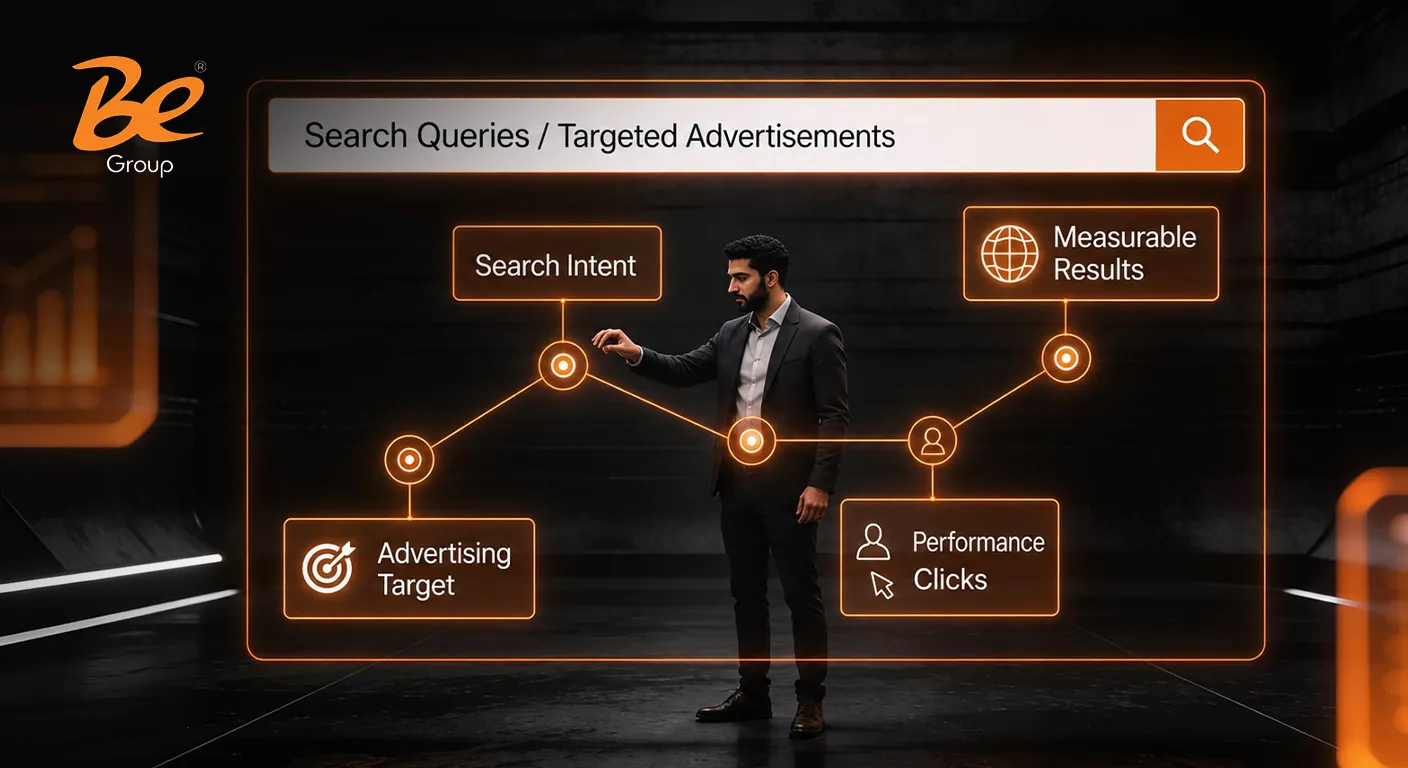
Search advertising can bring customers who are ready to act, but it can also waste a budget on clicks that never become sales. A strong search engine marketing strategy connects every keyword, ad, and landing page to a clear business goal.
The impact can be significant: according to a Google case study, Sephora increased its campaign conversion rate by 42% and improved return on ad spend by 13%.
The difference came from better targeting and campaign decisions, not simply spending more.
What is search engine marketing?
It is a paid promotion on search engines like Google and Bing. A business selects searches, creates ads, and pays when users click.
The search engine marketing meaning is broader than just buying traffic. It means using paid search to reach people while they are looking for a product, service, or solution.
SEO earns visibility over time, while paid search advertising can quickly place a business in front of customers when a campaign starts. Yet visibility alone is not the goal. A useful search engine marketing strategy focuses on qualified leads, calls, bookings, or purchases.
This makes paid search valuable when entering a market, promoting a high-intent service, or generating measurable demand.
The Search Engine Marketing Process
A reliable search engine marketing process begins before launch. Each step answers a business question:
- Define the campaign goal and action visitors should take.
- Study customers, competitors, locations, language, and seasonal demand.
- Group keywords by intent instead of placing every term together.
- Write ads that match the search and give people a reason to act.
- Send visitors to a focused landing page, not the homepage.
- Track calls, forms, bookings, purchases, and lead quality from launch.
These steps connect a search to a measurable result and give the campaign useful data. Without conversion tracking, automated bidding may optimize for clicks or weak leads.
Let Be Group build and track campaigns around your business goals.
Why Search Campaigns Waste Money?
Many campaigns lose money because keywords are selected based solely on volume. A broad term may attract students, job seekers, or people looking for free information instead of buyers. Negative keywords and search-term reviews help stop this waste. Google’s search terms report shows the queries that triggered ads, revealing irrelevant traffic.
Another problem is a gap between the ad and its landing page. If the ad promises one service but the page is slow, general, or unclear, interested users leave. An effective search engine marketing strategy treats both as one experience, with a clear offer, proof, and a simple next step.
Ask Be Group where your search budget is losing value.
Read Also: Digital Marketing Expert
How to Build a Search Engine Marketing Strategy?
Start with a result, not a traffic target. Decide whether the campaign should generate sales, consultations, calls, quotes, or visits. Giving each conversion a value keeps the search engine marketing strategy focused on revenue and demand.
Keyword selection should reflect search intent. “Digital marketing” may show research, while “digital marketing agency in Egypt” suggests provider comparison. Separate informational and high-intent terms, then add negative keywords for jobs, courses, tools, and unavailable services.
SEM Search Engine Marketing: Campaign Structure
A clear structure makes performance easier to control. Create focused groups for services, locations, or customer needs, with closely related keywords and ads. For example:
- Separate ecommerce, corporate, and landing-page development searches.
- Divide medical campaigns by treatments, doctors, and clinic locations.
- Split Egypt, Saudi Arabia, and UAE campaigns by market.
The page after the click must continue the ad’s message. A campaign for ecommerce development should open a service page.
Relevant work, a process, proof, and next steps help the search engine marketing strategy turn interest into action.
How AI Is Changing Search Engine Marketing in 2026?
People are using longer and more detailed searches instead of relying only on short keyword phrases.
This gives advertisers more information about customer intent, but it also means that fixed keyword lists may miss valuable searches.
- Broader search coverage: AI Max can identify relevant queries that are not included in the original keyword list.
- Better campaign results: Google reports that advertisers using AI Max are seeing 27% more conversions than those using manual campaigns.
- More relevant messages: Ad text and landing pages can be adjusted to match the meaning and context of each search.
- New advertising formats: Google is testing Conversational Discovery ads, Highlighted Answers, and lead-generation agents within AI-powered Search experiences.
- Greater need for accurate data: Conversion tracking, lead-quality feedback, and clear business goals help AI optimize for valuable customers instead of low-cost clicks.
- Continued human control: Marketing teams still need to review search terms, exclusions, ad messages, and landing pages to prevent wasted spending.
Search Engine Marketing Management
Search engine marketing management is ongoing work. Queries change, competitors adjust offers, and costs rise.
A manager should review search terms, add negative keywords, test messages, check location and device performance, and cut weak segments only after collecting data.
Testing should answer a question at a time. Does a price-led message attract buyers? Does a shorter form increase weak leads? Does a city-specific page improve calls? Each answer refines the plan and guides the next test.
Improve paid search decisions with Be Group.
What Search Engine Marketing Reports Should Show?
Useful search engine marketing reports connect ad activity with business outcomes. They should include:
- Conversion rate and cost per conversion.
- Qualified leads, completed sales, and generated revenue.
- Return on ad spend when revenue tracking is available.
- Search terms that spend without producing value.
- Performance by campaign, location, device, and landing page.
A report should explain what changed, why, and what happens next. Numbers without context leave managers guessing.
Clear reporting turns the search engine marketing strategy into a management tool that protects budget, reveals growth opportunities, and supports planning.
Search Engine Marketing Strategy Lessons from Global Brands
These results show what can change when search campaigns rely on customer intent and useful data instead of simply increasing ad spend.
Royal Canin
Used AI Max for Search to reach queries and adapt ads to customer interests.
Google reported a 263% increase in conversions and 73% reduction in cost per acquisition without higher spending. Better relevance helped the budget produce more.
Etihad Airways
Used remarketing lists to adjust bids for previous visitors. Google reported that its acquisition cost was 60% lower than regular Search campaigns.
The lesson is that a search engine marketing strategy improves when customer history, intent, and value guide bids.
A Search Engine Marketing Program for the Egypt Market
A regional campaign should not treat countries as one audience. Language, purchasing power, buyer expectations, competition, and lead costs differ across Egypt, Saudi Arabia, and the UAE. Arabic wording varies, while business and technology searches often mix Arabic with English.
Create campaigns and landing pages for each market. Adjust locations, schedules, currencies, offers, and calls to action, then compare lead quality by country.
A regional search engine marketing strategy should account for Ramadan, national events, sales seasons, and local workweeks.
How Be Group Manages Paid Search?
Since 2009, Be Group has been helping brands grow through performance-driven search marketing.
- We analyze the offer, audience, competitors, and available data to build a clear foundation for every campaign.
- We structure keywords, ad groups, ads, landing pages, tracking, and reporting around measurable business goals.
- We continuously optimize after launch through search-term analysis, negative keywords, bid adjustments, A/B testing, and landing page improvements.
- We deliver clear performance reports focused on leads, sales, cost efficiency, and revenue where tracking is available.
- Since 2009, we have worked across multiple industries including e-commerce, real estate, healthcare, education, and tourism, supporting both regional and local brands across Egypt and the Middle East.
Let Be Group handle your search planning and reporting.
FAQS
Many business owners also ask how search marketing works and which strategies can help them attract the right customers.
What is SEO vs SEM?
SEO improves a website’s unpaid search visibility over time, while SEM uses paid search ads to gain immediate exposure. SEO supports long-term traffic, whereas SEM offers faster, budget-controlled results.
What are the marketing tactics for search engines?
The main tactics include SEO, paid search ads, keyword targeting, negative keywords, local search optimization, landing-page improvement, and conversion tracking. Each tactic should support a clear business goal.
What are the 5 main marketing strategies?
Five core digital marketing Strategy are SEO, SEM or PPC, content marketing, social media marketing, and email marketing.
The right mix depends on the audience, budget, sales cycle, and business goals.
Are SEM and Google Ads the same thing?
No. SEM is the paid-search method, while Google Ads is one of the platforms businesses can use to run SEM campaigns.
How does an SEM ad auction work?
For every eligible search, the platform uses the bid, ad quality, search context, and expected impact of ad assets to decide whether and where the ad appears.
Can SEM work for small businesses?
Yes. Small businesses can control costs, target specific searches and locations, and measure calls, leads, or sales before increasing their budgets.
Ready to turn search demand into qualified leads? Contact Be Group today to build a search engine marketing strategy.